

It’s February 2026. You open a brown envelope from the DVLA, and the words hit you like a physical blow: “Your driving licence has been revoked.”
For most drivers, this triggers instant panic. In an era of rising fuel duty, congestion charge hikes, and stricter enforcement cameras, losing your licence feels like the final straw. You rely on your car for work, family, and freedom.
But take a deep breath. Revocation is not the same as a ban.
While serious, revocation is often an administrative reset button rather than a criminal punishment. In 2026, the rules around medical revocations (especially for diabetes) and new driver probations have evolved. Understanding these nuances is the difference between months off the road and a quick return.
Whether you’ve been caught by the “New Drivers Act,” are navigating the new medical monitoring rules, or simply missed a letter, this guide is your up-to-date roadmap for getting back behind the wheel.
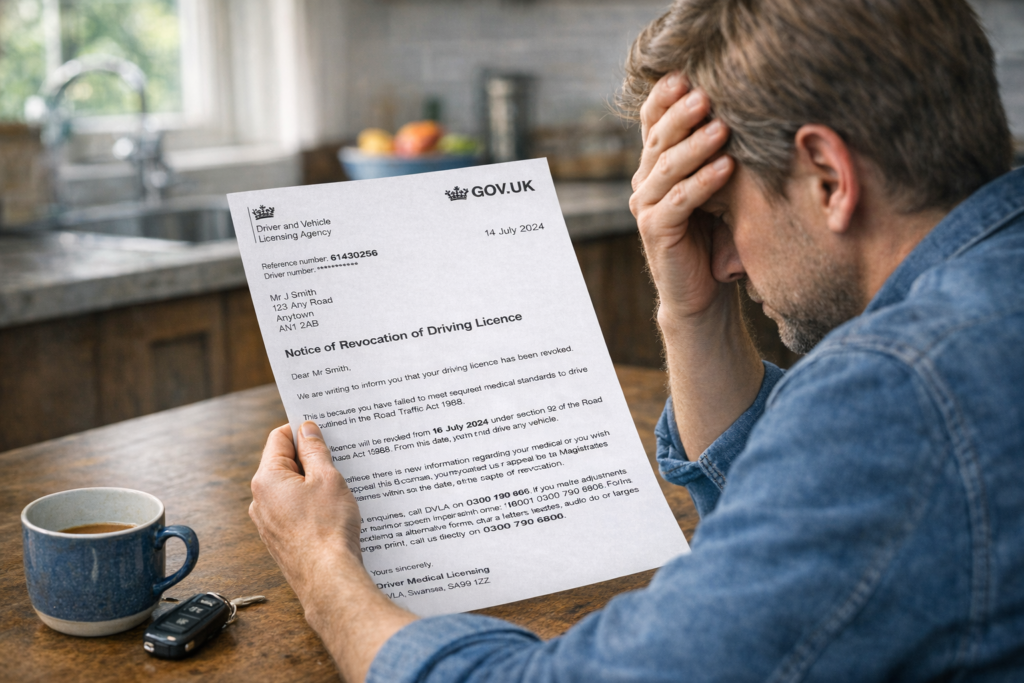
“Revoked” vs. “Disqualified”: The Critical Difference
Before you assume the worst, you need to understand your legal status. The terms “revoked” and “disqualified” are often confused, but in the eyes of the law, they are worlds apart.
- Disqualification (Banned): This is a punitive measure ordered by a court. You are strictly forbidden from driving for a set period (e.g., 12 months for drink driving). Driving while disqualified is a prison-able offence.
- Revocation (Cancelled): This is an administrative action by the DVLA. It means your current licence has been cancelled and is no longer valid. However—and this is the silver lining—you are not necessarily banned from applying for a new one immediately.
Think of it this way:
- Disqualification says: “You are dangerous, stay away.”
- Revocation says: “Your paperwork, health, or eligibility is invalid. Fix the issue, and you can reapply.”
Reason #1: The New Drivers Act (The “6-Point” Rule)
Despite rumours of “Graduated Driving Licences” changing the landscape in 2026, the Road Traffic (New Drivers) Act 1995 remains the primary law for new drivers in Great Britain.
If you passed your first full driving test less than two years ago, you are in a “probationary period.” Under this law, your licence is automatically revoked if you accumulate 6 or more penalty points.

The 2-Year Probationary Period Explained
Many new drivers mistakenly believe they have the standard 12-point buffer. You don’t.
- The Trap: A single speeding offence (3 points) followed by a minor traffic light error (3 points) equals 6 points.
- The Result: Immediate revocation. No court hearing, no “pleading your case” to the DVLA. The computer simply triggers the cancellation.
The 2026 Reality: Why There is No “Loophole”
With the rollout of digital licence records and smarter enforcement cameras across the UK this year, the link between points and revocation is faster than ever.
Expert Warning: “Do not ignore a Fixed Penalty Notice hoping it will go away. If you accept a penalty that takes you to 6 points, you are signing your own revocation. Once the points are on the licence, the revocation is automatic and cannot be appealed directly.”
The Path to Reinstatement (Theory & Practical Retests)
Unlike a disqualification, you don’t have to wait out a ban. But the process is rigorous:
- Apply for a Provisional: You must complete form D1 and pay £43 to downgrade to a provisional licence.
- L-Plates On: You are essentially a learner again. You must display L-plates and drive with a supervisor.
- Retake EVERYTHING: You must book and pass your Theory Test and Practical Driving Test again.
Note: Passing these tests gets your licence back, but the points stay on your record for usually 4 years. If you hit 12 points total, you then face a standard 6-month court ban.
Reason #2: Medical Revocation (2026 Updates)
The DVLA’s medical standards have tightened in some areas and become more flexible in others. If the DVLA believes you suffer from a “relevant disability,” they can revoke your licence to protect public safety.
New Diabetes Rules (CGM & Flash Monitoring)
A significant update for 2025/2026 concerns drivers with diabetes.
- The Change: The DVLA now widely accepts data from Flash Glucose Monitoring and Continuous Glucose Monitoring (CGM) systems.
- The Benefit: You may no longer need to rely solely on finger-prick tests to prove your fitness to drive. However, you must still have 3 months of continuous data available if requested.
- The Risk: If your CGM shows recurring “severe hypoglycaemia” (low blood sugar) while driving, revocation is immediate.
Vision, Epilepsy, and Drug/Alcohol Standards
- Vision: Police are increasingly using roadside eye tests. Failing to read a number plate from 20 metres results in instant revocation (Cassie’s Law).
- Epilepsy: Typically requires a 12-month seizure-free period for reinstatement.
- Alcohol/Drugs: If revoked for misuse/dependency, you will likely need to pass a medical exam and provide blood tests showing liver function stability for 6–12 months before getting your licence back.
“Voluntary Surrender”: The Strategic Move
If your doctor tells you to stop driving, you face a critical choice: Wait for revocation or Surrender voluntarily.
Always surrender.
If you voluntarily surrender your licence, you can use Section 88 (see below) to drive as soon as your doctor says you are fit and you’ve reapplied. If you wait for the DVLA to formally revoke it, you generally cannot drive until their medical team has fully processed your application—which can still take months in 2026.
Section 88: Driving While Waiting for Your Licence
Section 88 of the Road Traffic Act is the “golden rule” for medical cases. It allows you to drive legally while your application is with the DVLA, if:
- Your doctor confirms you are fit to drive.
- You have held a valid licence previously.
- Your licence was not revoked by the DVLA (this is why surrendering is smarter!).
- You have a valid application currently processing.
Other Common Reasons for Revocation
Failure to Surrender for Endorsement (The “Digital” Trap)
Even as we move toward digital licences, some procedures still require you to physically send your photocard to the DVLA (e.g., if the digital record fails to update automatically after court). If you ignore these letters, the DVLA will revoke the licence simply for “failure to surrender.”
- The Fix: Send the licence immediately. The revocation is usually lifted quickly once they have processed the endorsement.
Administrative & Address Errors
If the DVLA receives mail returned from your address (marked “not at this address”), they may revoke your licence assuming you are uncontactable.
- 2026 Tip: Ensure your address is current on GOV.UK. Fines for outdated addresses can reach £1,000.
Step-by-Step: How to Appeal a Revocation
Appealing Medical Decisions (Magistrates’ Court)
You can appeal to your local Magistrates’ Court (or Sheriff Court in Scotland) within 6 months.
- Evidence is King: You cannot win on sentiment. You need a Consultant’s report that directly contradicts the DVLA’s medical assessment.
- Cost Warning: If you lose, you may be liable for the DVLA’s legal costs.
Challenging New Driver Revocations
You cannot appeal the revocation itself—it is automatic legislation.
- The Strategy: You must appeal the conviction or sentence (points) that triggered it.
- Example: If you were given 3 points for a tyre offence but can prove you weren’t the driver, appealing that specific conviction in court could remove the points. If your total drops below 6, the revocation is rescinded.
Conclusion: Your Roadmap to Reinstatement
A revocation letter in 2026 is a hurdle, not a dead end.
- For New Drivers: Acceptance is the fastest path. Book your theory test immediately. View this as a costly refresher course rather than a disaster.
- For Medical Cases: Leverage the new rules. Use the “Voluntary Surrender” strategy to maintain control over when you can get back on the road.
The laws are stricter, and the enforcement is smarter, but the pathway back to driving is clear. Don’t drive while revoked—the risk of a criminal record isn’t worth it. Check your status, follow the steps, and you’ll be back in the driver’s seat legally.
Next Step: Not sure if your licence is currently valid? Don’t guess. Use the GOV.UK “View or share your driving licence information” service immediately to see your live status.
